A Flower Sprite Grants Maya’s Wish
The Adventures of Maya the BeeA Flower Sprite Grants Maya’s Wish turns Maya’s long-standing curiosity about human beings into a singular night of encounter and discovery. One of the Flower sprites offers to fulfill her wish before his death, and leads her to a scene of human love that reshapes what she understands as human beauty. The wish is granted not through an explanation of humanity, but through Maya’s act of seeing two people together.
Background and the Midsummer Night
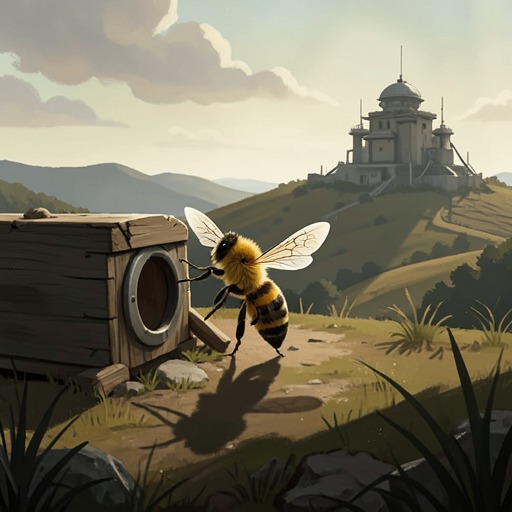
Maya’s longing has survived an earlier incident involving a child and a mosquito: although she remembers it in every detail, it has not satisfied her desire to know human beings well. Instead, she decides to be bolder and to keep trying. The event answers that persistent desire in a way she had not imagined, beginning on a warm evening when she goes to sleep earlier than usual and wakes in the middle of the night, something that has never happened to her before.
Her bedroom is filled with a quiet bluish radiance that shines through its entrance like a silver-blue curtain. Maya does not move at first, not from fear but because the light arrives with a rare peacefulness, accompanied by a sound more harmonious than any music she has heard. When she ventures outside, the familiar landscape has become strange in its appearance: birch trunks and sleeping leaves seem overlaid with silver, while the grass glitters with pale, pearl-like points. The soft sheen reaches even the silent distances. Maya recognizes the night as exceptional and leaves her room, drawn into the moonlit world.
The Musician and the Flower Sprite
As Maya sets out toward her favorite meadow, she sees a winged creature land on a beech leaf. It raises its head toward the moon and draws one narrow wing against the other as if playing a violin. The silvery chirp that follows fills the night with melody. Maya approaches, but when she touches the leaf, the playing stops abruptly; the resulting hush makes the darkness and the cool white light filtering through the leaves newly palpable. Her exploration proceeds through such changes of attention: music gives way to silence, and the quiet night opens onto another marvel.
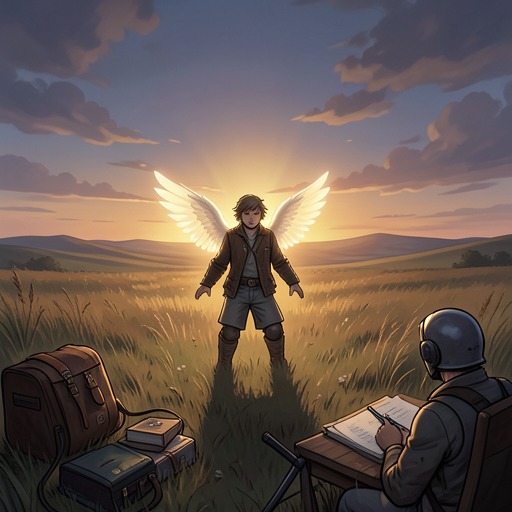
A song rises from an iris nearby, clear and unlike any earthly sound Maya knows. As the flower sways, a tiny white hand appears at the edge of a petal, followed by a small blond head and a delicate, luminous figure in white garments. A human being in miniature is emerging from the iris. Maya sits rigid with awe. The new arrival is one of the Flower sprites, and his appearance makes literal the extraordinary quality of the night: a creature that resembles a human being, yet is small enough to rise from a flower, has entered her path.
The Wish and Its Cost
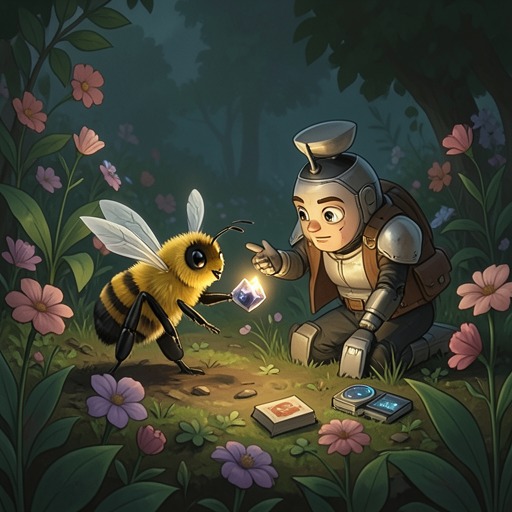
The sprite explains that most of the Flower sprites are glad to leave their flowers and not return, because their departure is connected to great happiness. Before they die, they can fulfill the dearest wish of the first creature they meet. Their wings grow when they seriously resolve to leave the flower in order to make someone happy. The gift therefore has a cost and a condition: granting a wish is bound to the sprite’s approaching death, and the recipient must be the first creature encountered.
Maya is moved by the prospect of making someone happy and says she would leave a flower for that purpose too. She asks whether the sprite must die; he nods, no longer sadly. Although she is the first being he met on leaving his flower, Maya does not yet realize that this makes her wish the one he can grant. When he invites her to name it, she admits that she wants to know human beings at their best and most beautiful. The sprite takes her trembling hand and assures her that her wish will be granted. Their agreement turns the night’s wonder into a journey with a precise destination: Maya is to encounter not humanity in general, but the form of human life she most longs to understand.
The Scene in the Jasmine Arbor
The two fly together over a blossoming meadow in the bright midsummer night. Later, they reach an arbor overgrown with jasmine and woodbine, where faint whispering can be heard from within. To get through the dark leaves, the sprite asks a firefly for a little light. He then bends aside a blooming sprig and guides Maya to look down, presenting the sight without explaining what it means.
On a bench in the moonlit shadows sit a boy and a girl. She leans her head on his shoulder, and he holds his arm around her as if protecting her. They remain still and wide-eyed, while crickets chirp at a distance and moonlight drifts through the leaves. Maya studies the girl’s pale, wistful face, which seems lit by hidden happiness, and the golden hair that recalls the sprite’s. The girl turns toward the boy, draws his head down, and whispers to him. His answering expression appears to Maya to hold happiness and vigor beyond anything she had thought earthly people could show. She does not wish to know what he says in reply; the sight itself has already moved her.
Maya recognizes love as the answer to her wish. She whispers that she has seen the most glorious thing her eyes will ever behold, and that human beings are most beautiful when they are in love. The discovery is both specific and expansive: she has not learned everything about human beings, but she has witnessed a moment that gives her a new standard for their beauty. Her own heart seems to share in the happiness she sees, so the encounter grants knowledge through feeling as well as observation.
Dawn and the Meaning of the Wish
Maya remains behind the leaves, absorbed in watching the couple, for so long that she does not know how much time has passed. When she finally turns, the firefly’s lamp has gone out and the sprite is gone. Beyond the arbor, a narrow red streak marks the distant horizon. The disappearance and approaching dawn place a limit around the vision: the companion who enabled it does not remain, and the night that made it possible is ending.
By the time Maya wakes in her woodland retreat, the sun is high above the beech-trees. At first the moonlight, the crickets, the meadow, the sprite, and the couple seem like the vanishing fancies of a delicious dream. But she remembers slipping back into her chamber in the chill of dawn, and understands that the night was real. The event thus closes with recognition rather than uncertainty: the wish has carried her beyond her usual experience, and its proof lies in the remembered journey and the scene she witnessed. The sprite’s rule has made a self-sacrificing departure the means of another creature’s happiness; for Maya, its consequence is a lasting discovery about love and human beauty.